
The operating layer for ambitious internet companies.
Ship faster. Integrate deeper. Stay accountable.
Ready to ship?
Install the CLI and have a service deployed in under fifteen minutes.
Built for the engineers who ship.
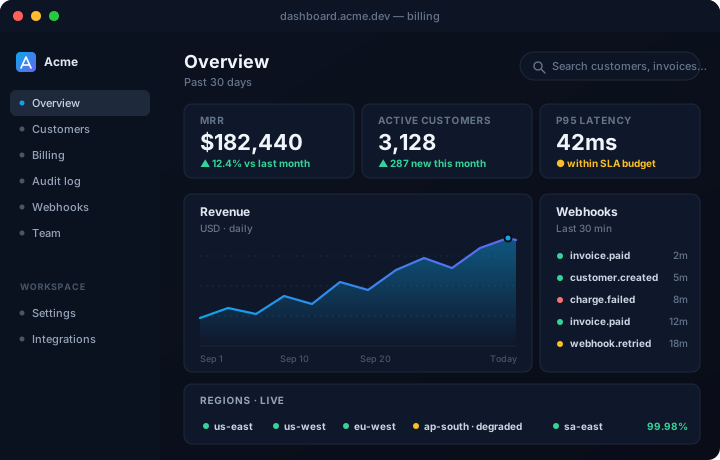
A typed SDK, an OpenAPI spec, a managed edge runtime, and a control plane — all wired together before you write your first handler.
Everything in the monorepo.
Browse the dashboard app, the edge runtime, and the official SDK.
Apps
Standalone applications and runnable services — APIs, workers, web apps, and anything that deploys independently.
Packages
Reusable modules shared across the codebase — libraries, utilities, configs, SDKs, and internal tooling.
One config. Validated at boot.
Acme services are described by acme.config.ts. The SDK validates against your live database schema on deploy — drift never ships.
- ✓Typed handlers, typed events, typed database
- ✓Schema drift caught at typecheck time
- ✓Feature flags + audit retention next to code
- ✓Per-environment overrides without forking
Deploy from anywhere.
The CLI ships your handlers to every region in a single pass, with health gates between waves.
- ✓Regional canaries by default
- ✓Instant rollback to any prior build
$ acme deploy --env production

 ▸ building 3 handlers
 ✓ us-east  healthy (12 isolates)
 ✓ eu-west  healthy (8 isolates)
 ↻ rollback available: acme rollback billing@41
Four surfaces, one platform.
Write a handler, ship a route
Every exported handler becomes an edge route with a typed client method.
- ✓Typed request + response
- ✓Zero routing config